Mass layoffs or ‘job notifications’? Advance’s attempt to spin its Deep South newspaper guttings

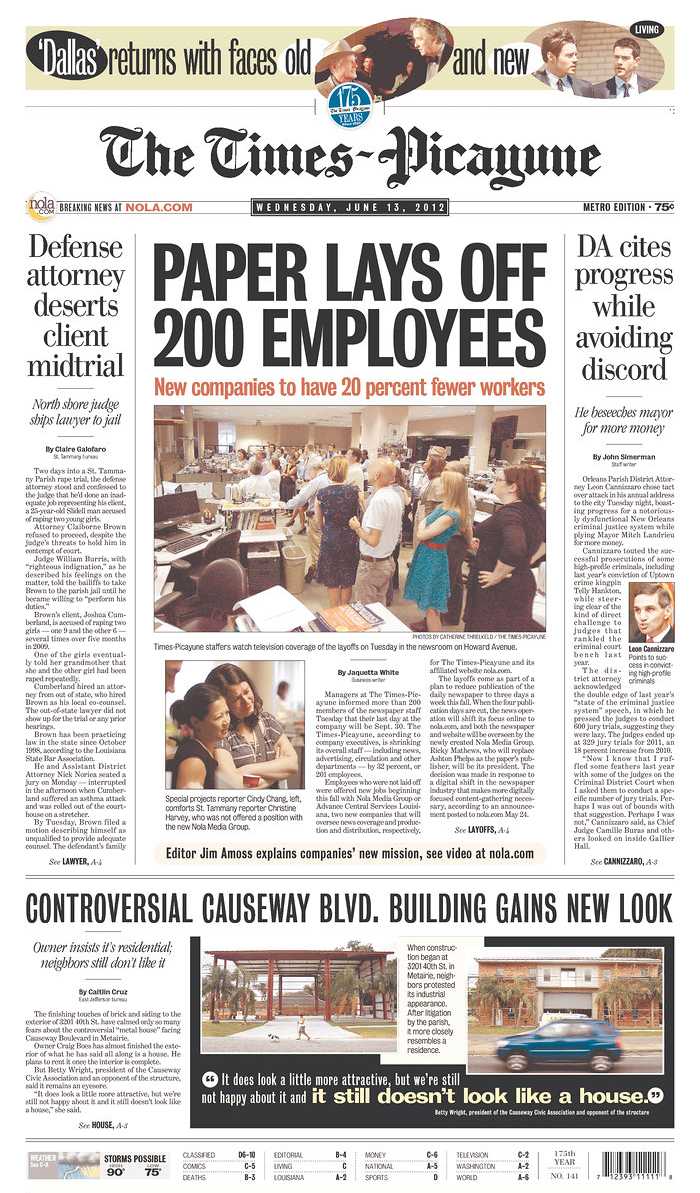
Six hundred employees at four Deep South newspapers lost their jobs Tuesday, as Advance Publications continues its transition to primarily digital news. The cuts hit newsrooms surprisingly hard, especially in the wake of Advance’s earlier commitment to “significantly increase online news-gathering efforts” and offer “richer” “deeper” “robust” “enhanced printed newspapers on a scheduled of three days a week.”

In May, Advance announced limited print schedules and a revamped online approach for the New Orleans Times-Picayune, the Birmingham News, the Mobile Press-Register, and the Huntsville Times.

[RELATED: Times-Picayune, part of New Orleans culture, scaling back; Alabama papers hit, too]

The Times-Picayune lost 49% of its news staff on Tuesday. The Birmingham News purged 60% of their journalists. In moves that cut roughly one-third of each newspaper’s overall staffing, it would seem that the actual news gatherers were hit disproportionately hard.

Advance promises that a portion of these positions will be refilled, no doubt by less experienced, more affordable reporters. Still, fulfilling the watchdog role of the press is awful tough work when there aren’t capable bodies there to do the groundwork.

And if yesterday’s events were any indication, the NOLA and AL media groups are going to have a lot of trouble covering their respective cities. Just look at how poorly they covered themselves…
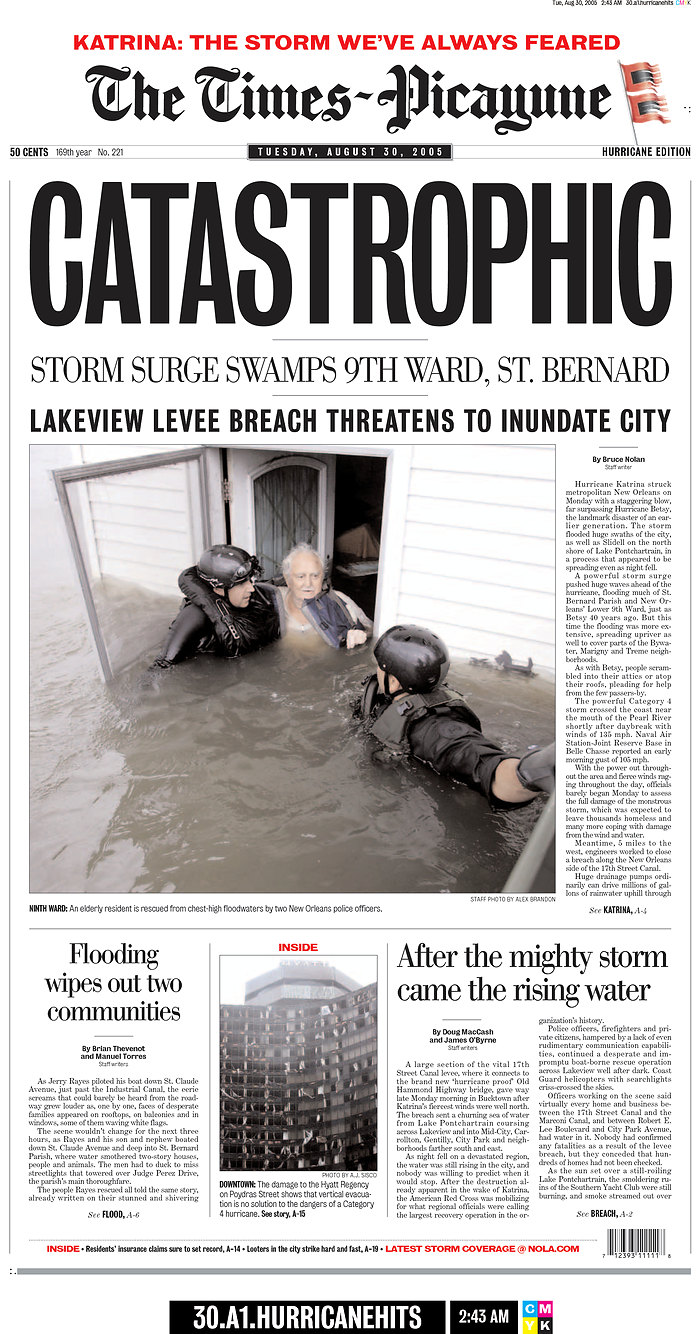
Continue reading “Mass layoffs or ‘job notifications’? Advance’s attempt to spin its Deep South newspaper guttings”

Fox News makes an anti-Obama attack ad: How production value impacts perception

Take a moment to watch this video:

Entitled “Four Years of Hope and Change,” you get dramatic visuals and music – a greatest hits of Barack Obama’s first term as president. Well, if you didn’t like the guy, anyway.

The facts seem to be fine from a cursory glance. It would be an excellent creation of the Romney campaign or some political action committee. Thing is, it wasn’t a creation of a blatant activist group. It was produced by Fox News and ran multiple times Wednesday on its morning infotainment program Fox & Friends.

Continue reading “Fox News makes an anti-Obama attack ad: How production value impacts perception”

Times-Picayune, part of New Orleans culture, scaling back; Alabama papers hit, too

Today is another in an almost decade-long line of sad days for the newspaper industry. Ownership of the New Orleans Times-Picayune announced Thursday that the newspaper will cut its print distribution to three days a week and shift resources to its website, NOLA.com. By the end of the afternoon, three more dailies in Alabama had been similarly downsized.

This is not just another small newspaper trimming down, or a competing paper in a large city getting out of the print business. With a daily circulation of over 150,000, the Times-Picayune is the largest newspaper to scale back printing dates and New Orleans is now the largest city in America without a daily newspaper, according to Poynter.

The move is part of a larger strategy for the newspaper’s ownership group, Advance Publications (often referred to as Newhouse, after the family that owns the company). Hours after the Times-Picayune news, Advance announced the same print schedule for the Birmingham News, Press-Register of Mobile, and the Huntsville Times – leaving three of the state’s four largest cities without a daily newspaper. The Alabama newspapers will place more emphasis on AL.com. Advance also recently consolidated a number of their Michigan newspapers and decreased printing days, eliminated home delivery, or took both measures in various markets.

The new NOLA Media Group promised more intensive online news-gathering “24 hours a day, seven days a week,” and feature-heavy print editions on Wednesday, Friday, and Sunday – “the most valuable days for the newspaper’s advertisers,” said NOLA’s president Ricky Matthews in the group’s official release Thursday morning.

Continue reading “Times-Picayune, part of New Orleans culture, scaling back; Alabama papers hit, too”

Teaching September 11

One of my senior-level seminar courses took a break from our normal lecture schedule last week to look back at the September 11, 2001 terrorist attacks and their impact on journalism, culture, and diplomacy in the United States and abroad. I titled the series, “Effects of 9/11 – 10 Years Later,” and opened it to students across the campus.

With the immense anniversary coverage being prepared for the weekend ahead, it seemed like an excellent opportunity to look back (For more on the extent of the coverage, see Paul Farhi’s piece in the Washington Post). The idea gained steam with the launch of the new Understanding 9/11 page from the Internet Archive, a massive collection of television coverage from the original Sept. 11, 2001 broadcasts of major news networks around the world.

I arranged the lectures around clips from the archive and other corners of the Internet. I was quite pleased with the discussions that took place. My colleagues and I wondered if the students – most of them 10-11 years old when the attacks occurred – would have the same memories of that day as we do. As it turned out, the associations were still strong, and sparked some great debate.

Continue reading “Teaching September 11”

Perceived Media Bias and Cable News Branding: The Effects of Diversification in the Marketplace of Information

This presentation was given Saturday at the AEJMC Annual Conference as part of a refereed paper research session on “Bias and Branding” sponsored by the Radio-Television Journalism Division. This is a rudimentary script to an oral presentation with visual aids, so it will leave a bit to be desired for the blog reader.

For the PowerPoint accompanying this presentation, email Dylan.

For more on the conference as a whole, view my main post on AEJMC ’11.

Claims of media bias are nothing new. And despite plentiful content analyses that show little to no evidence of some collective attempt to mislead the public, perceptions of bias not only remain, but have increased dramatically over the past decade, a time frame that correlates with the rise of Fox News and MSNBC – cable news networks to compete with CNN and create a competitive marketplace.

Researchers like Sutter or Anand, DiTella, and Galetovic have looked at news coverage economically, and cable news as just what it is – a for-profit industry. That means, like any differentiated product market, the news outlets must seek a place along a continuum of potential audiences. With radio stations, it would be genres of music; with news it could be the types of stories covered (intl/domestic; hard news/entertainment), but we often think of it in terms of political ideology.

The suggestion is that our oft-idealized paradise of objectivity doesn’t make good business sense, because wide-open market segments are left untapped while everyone battles for the middle. If every station in town is playing country music, why don’t you try reaching out to the hip-hop fans? (Ideology isn’t quite so drastic, but you get the idea.)

So instead, content analyses (or a casual channel surf during primetime) have suggested that the cable news environment looks something like this. Each network has differentiated, targeting its own particular audience. Which begs the question… How do these differentiation attempts influence the audience’s perceptions of bias in those networks?

Continue reading “Perceived Media Bias and Cable News Branding: The Effects of Diversification in the Marketplace of Information”