Mississippians are passionate about our state. We know more about our famous alumni than most colleges. We celebrate our successes in spite (or because) of our status as the perennial underdog. And that means that when someone on the national stage disparages Mississippi, we attack… like Bulldogs, perhaps.
Midway through the first game of the College World Series finals, social media simmered with reports that the ESPN broadcast had taken at shot at the poorest state in the nation:
The people from Mississippi can't afford to be in Omaha? Real Classy @espn
Oklahomans must be thankful to see the calendar turn to June. The month of May was devastating in the heart of tornado alley, right down to the final day. On May 31, a tornado rolled over the Oklahoma City metro area, killing nine. As the ingredients came together for a particular dangerous storm, the right mix was also present for a media catastrophe.
On NBC-affiliate KFOR, chief meteorologist Mike Morgan told viewers in the storm’s path to get underground or “go south” – advocating evacuation as a tornado approached. Telling people to leave their homes and get in their cars earned criticism from fellow meteorologists, and made this blog post written one day earlier seem prophetic.
Presented March 1, 2013 at the AEJMC Southeast Colloquium, Tampa, Fla. Electronic News Division, Top Paper Award.
To request the accompanying PowerPoint, email Dylan.
To read the abstract and request the full paper, go to the Academia page on dylanmclemore.com.
SYNOPSIS:
Party nominating conventions used to be messy and meaningful. Today, they’re more pomp and circumstance. It’s no wonder the broadcast television networks pay far less attention to them now than in decades past. For cable news, on the other hand, the conventions provide fuel – or at least a moving backdrop – to the 24-hour news cycle. And in the pauses between speakers, the talking heads weigh-in with their analysis.
There is a healthy amount of research suggesting that the party nominating conventions can influence voters, as well as a stack of studies that indicate media analysis of political events can influence voters. However, the specific cross-section between conventions and commentary has not been evaluated.
Does instant media commentary affect perceptions of convention speeches? This study lays the foundation for that investigation by looking at how favorably (or unfavorably) different news networks covered the 2012 Republican and Democratic national conventions.
We looked at a large sample of live convention coverage – all six nights of primetime (10 p.m. E.T.) on the three major broadcast (ABC, CBS, NBC) and cable (CNN, Fox News, MSNBC) networks. Here’s what we learned:
Convention coverage was generally favorable to the host party.
Bias was indicated by an exaggeration of this positive commentary, and near absence of negative commentary (for instance, coverage of the DNC on MSNBC was 3% negative; the RNC on Fox News was only 2% negative). In other words, unbalanced coverage was not the result of tearing one side down, but by disproportionately praising the other.
The largest differences in valence were observed on Fox News & MSNBC, though some statistical tests revealed evidence of bias in traditional network broadcasts.
We look forward to enriching this study with further data from the content analysis, including potential explanatory mechanisms. Next, we desire to test the effects of such instant media commentary on the audience. We extend our thanks to the School of Mass Communications at the University of South Florida for hosting the event, and the paper judges for honoring us with the Top Paper Award in the Electronic News Division.
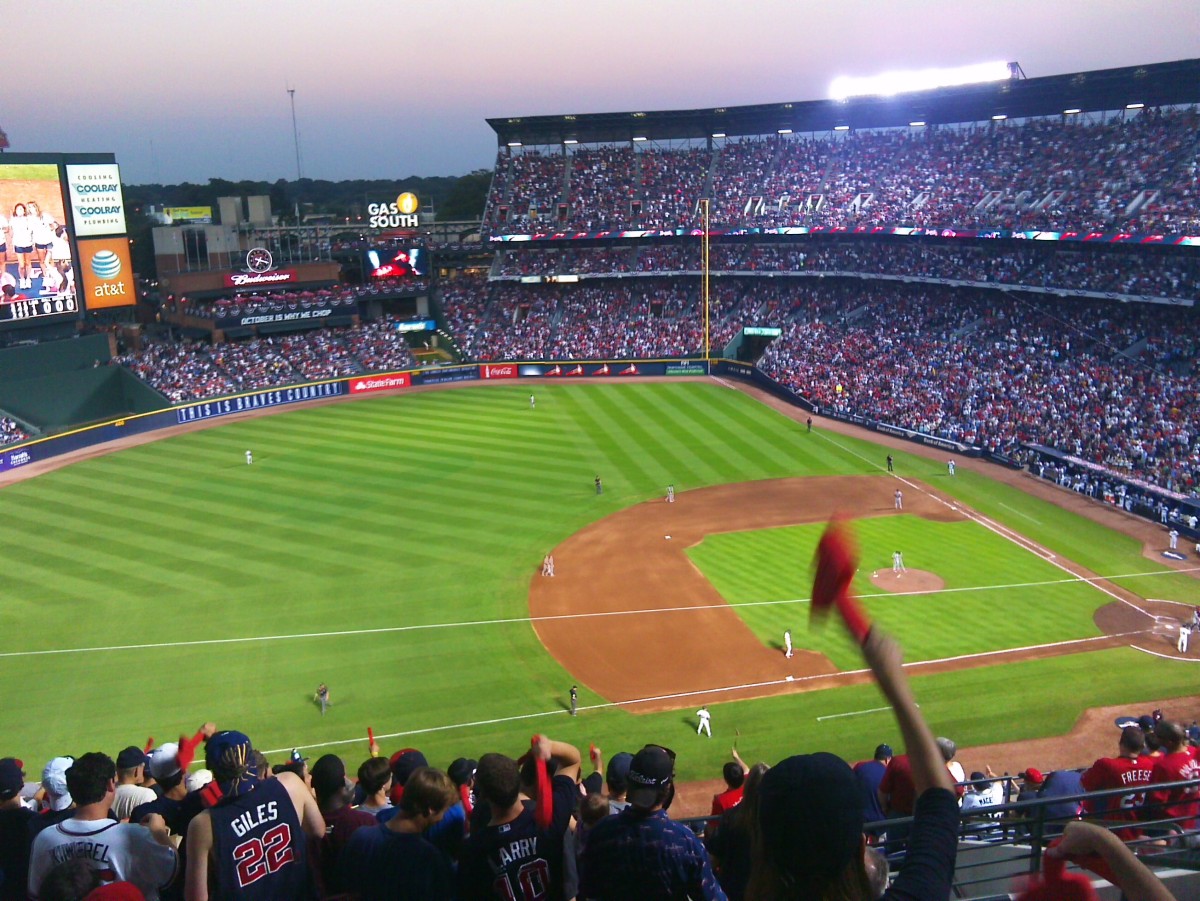
I was at Turner Field in Atlanta Friday to watch the St. Louis Cardinals defeat the Atlanta Braves 6-3 in the first-ever Wild Card Play-in Game as part of the newly designed MLB Postseason.
The Braves played a terrible ballgame. They committed three errors, each leading to Cardinal runs. St. Louis managed only six hits, but scored six runs – four of them unearned. Atlanta, meanwhile, racked up 12 hits, but managed just three runs, leaving 10, 12, 18, 21 runners on base, depending on where you look (seriously, is it that difficult?).
The starting lineups before the game, as seen from my seats in the upper deck.
But none of that merits a blog post.
Then, “the call” was made by left field umpire Sam Holbrook in the bottom of the eighth inning – the common sense-defying, if not rule-defying application of the infield fly rule to a ball landing in the outfield some 225 feet from home plate.
How Holbrook could reason that St. Louis shortstop Pete Kozma was exercising “ordinary effort,” or was “in position” to catch a ball he couldn’t see, or, to the casual observer, was anywhere near the infield, is beyond me. How Holbrook could think that the Atlanta baserunners were in any danger of being deceived into a double play and would be aided by his raising of an index finger less than a second before the ball hit the grass is again unfathomable.
How Holbrook could feel inanimate being relegated to calling fair or foul balls down a chalk line in the outfield; how he would desire to do something, even if it was out of his jurisdiction… that makes a little more sense.
But none of that merits a blog post, either.
Is the Wild Card Game right for baseball? Chipper Jones prophetically stood out against it just two weeks prior to the game being his last:
You say to yourself, we could possibly have the second- or third-best record in the National League when the season’s over and we have to play a one-game playoff just to get in, that doesn’t seem fair because anything can happen [in one game]. Now if you were to say the two wild-card teams will play a best two-out-of-three [series], I’d be OK with that. We play three-game series all the time, and we concentrate on winning those series all the time. I think it’s more fair from a standpoint that anything can happen in one game — a blown call by an umpire, a bad day at the office … at least in a two-of-three-game series you have some sort of leeway. [emphasis added]
Well before last night, I had sided with Jones. You don’t follow a 162-game regular season with a best-of-one playoff round. More than any other sport, the series is essential to baseball. Even a bad team can have one dominant pitcher capable of winning one game. Winning the Postseason rounds that follow require more complete teams than a one-game play-in can adequately determine.
But it’s great for ratings. And attendance. I don’t know if I would have made the drive to Atlanta for a Divisional Series contest. Knowing that I would see a definitive outcome at the end of that one game got me to the ballpark. Wild Card Play-in: Bad for baseball, but I loved it in person. The claim of hypocrisy is self-evident and duly noted.
But again, though my word count is getting there, none of this inspired me to write.
Tuesday was one of the greatest days in U.S. Olympic history. After early struggles in the pool, Michael Phelps and his American teammates captured gold in the 200-meter freestyle relay. It was Phelps’s second medal of the day and his 19th overall, making him the most decorated Olympian ever.
Across the Olympic Park, the U.S. women’s gymnastics team took home gold for the first time since Kerri Strugg and the 1996 Atlanta squad. This 2012 team is better, say those who know something about gymnastics.
Gold in premiere sports, drawing even with the Chinese atop the overall medal count – it was a banner day for the Stars and Stripes.
But as I write this Tuesday evening, Americans are the only people in the first world who haven’t seen any of it happen.
Don’t worry, though, it’s 7 o’clock. NBC is pushing play on the VCR right about now.




 dylan mclemore