I watched my first NASCAR race in at least five years Monday night. By early Tuesday morning, Matt Kenseth had won the Daytona 500.
No one cared about that.
It was a weekend full of rain, and when the race finally started, it might as well have kept on pouring to save us from endless laps of drivers laying back and playing it safe.
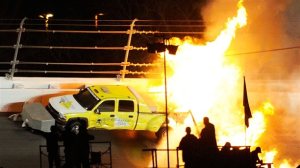 Then, Juan Pablo Montoya crashed into a jet dryer during a caution, sending gallons of jet fuel pouring down the steep bank of turn three. Whole thing caught on fire. Big fire. During the two-hour red flag, we endured the FOX broadcast team’s filler antics and learned a new use for Tide laundry detergent.
Meanwhile, Brad Keselowski, relatively unknown driver of the #2 Miller Lite Dodge, was sending this Tweet – an in-car view of the fire on the track. Keselowksi had his phone with him in his car, and during the red flag stoppage, took to Twitter… a lot.
Keselowski Tweeted 39 times over the next two hours. When the race finally resumed, he fell victim to one of many wrecks in those final 40 laps. Just minutes after his battered car came to rest upon the midfield grass, came this:
https://twitter.com/#!/keselowski/status/174367097344884737
Fans – the hardcore and the casual – ate it up. Keselowski boosted his Twitter following by more than 100,000 people, the exact number depending on your source. The first interaction with fans from a driver while he was in the car on the track… pretty cool stuff. And while it was true that he – along with every other driver on the speedway – was stopped, it still gave birth to the notion of texting and driving at 200 m.p.h.
Perhaps a Facebook poke while bump drafting? Too much?
I couldn’t help but think that the sport’s first in-car Tweet would also be its last. After all, Major League Baseball, the NFL, the NBA – none of the major sports allow the use of social media in-game. Coaches want their players’ heads in the game, not in the Twittersphere. Owners don’t want their players sharing something stupid in the heat of the moment with their Facebook fans.
But this is the brandiest of all sports brands. CNBC sports business reporter Darren Rovell said as much during his coverage of the race (on Twitter, of course). Tuesday morning, NASCAR announced that Keselowski would not be fined for his actions:
“NASCAR will not penalize Brad Keselowski for his use of Twitter during last night’s Daytona 500. Nothing we’ve seen from Brad violates any current rules pertaining to the use of social media during races. As such, he won’t be penalized. We encourage our drivers to use social media to express themselves as long as they do so without risking their safety or that of others.” [emphasis added]
In a sport where drivers spit, cuss, and hurl helmets at one another and it’s a good thing, what is there really to lose by allowing live Tweeting? And there is plenty to gain. FOX’s Daytona coverage was all about the Tweety bird, and the stars of the event participating would only add to the experience.
I’ve already written once this month about how Twitter has become the world’s sports bar. When big games are on, reading a Twitter feed can be just as entertaining as the event itself (if not moreso). But while we can read the thoughts of reporters, insiders, and the uniquely witty, LeBron James isn’t part of our immediate Miami Heat discussion. Chad Ochocinco isn’t jumping into his team’s game chatter (anymore). Even the Florida erm… Miami Marlins’ Logan Morrison, who is a bigger star because of his Twitter presence than his on-field presence, isn’t allowed to chime in until after his game is over (and even then, he better be careful).
NASCAR could be different. Of course, it may not seem like it would matter much. After all, chances are you’ll hear those same drivers being interviewed moments after whatever they could have Tweeted. That’s not the point. It has more to do with this feeling of interaction – that the drivers themselves are participating in our Average Joe discussion (Of Keselowski’s 39 Tweets, 34 were replies or retweets). That brings the sport closer to home than any other league has managed thus far. And that could make 800 left turns at Daytona a little more engaging.

 Ah, the regional blackout. Designed to protect television and radio networks from hemorrhaging audience share to competing outlets, thus insuring lucrative broadcast rights, blackouts are part of making the games work financially for all parties. Traditionally, it kept national broadcasters from airing games in the two teams’ hometown markets. So, if ESPN wanted to nationally televise a game between the Tampa Bay Rays and the Detroit Tigers, they can do so. But, folks in Florida and Michigan wouldn’t be able to see the ESPN broadcast, because local television contracts require that the hometown broadcast be the only show in town. Same thing for the NBA, NHL, and major college athletics. There are exceptions, but you get the general principle.


 dylan mclemore