Understanding “fake news,” & why defeating it isn’t a fix-all

A version of this post later appeared as an article for NewsLab, a project of the University of Mississippi School of Journalism and New Media

After the dust from our toxic post-election discourse settled, the talk of traditional and social media turned to “fake news” – a term that has taken on new meaning in recent years, and new prominence in the 2016 presidential race.

In this iteration, fake news doesn’t refer to satire like The Daily Show or The Onion. Nor does it refer to news that is biased in its selection and interpretation of facts. No, for now we’re fighting a much simpler to identify foe – the peddling of information that is blatantly, demonstrably false and intentionally deceptive.

Stuff like these sensational – and completely fictional – headlines that circulated in the months leading up to the election:

Pope Francis shocks world, endorses Donald Trump for president, releases statement [Ending The Fed]

FBI agent suspected in Hillary email leaks found dead in apparent murder-suicide [Denver Guardian]

WikiLeaks CONFIRMS Hillary sold weapons to ISIS… Then drops another BOMBSHELL! Breaking news [The Political Insider]

Thousands of fake ballot slips found marked for Hillary Clinton! TRUMP WAS RIGHT!! [Donald Trump News]

President Obama confirms he will refuse to leave office if Trump is elected [Burrard Street Journal]

BREAKING: Hillary Clinton to be indicted… Your prayers have been answered [World Politic US]

Rupaul claims Trump touched him inappropriately in the 1990s [World News Daily Report]

This sort of nonsense has been around for a long time, previously circulating via your crazy relatives’ email inboxes. But it found new prominence this election cycle, on Facebook. Craig Silverman and his team at Buzzfeed compared Facebook engagement metrics on the top 20 fake news stories and the top 20 stories from a sampling of traditional media outlets across the final three quarters of the 2016 election. They found that after lagging well behind for most of the year, the most popular fake news out-engaged the most popular real news in the final three months of the race. (All of the headlines above were among the top 20 in that time period.)

*There are caveats to this method, and if you care, I discuss them at the end of this post. The point is that engagement with fake news has risen dramatically.

That has invited three questions – where is fake news coming from, does it have an effect, and what can be done to stop it? Continue reading “Understanding “fake news,” & why defeating it isn’t a fix-all”

Should debate moderators fact check? Polling, psychology & reaching Millennials

Tonight, a likely record-setting television audience will watch the first presidential debate of the 2016 election. And the majority of that audience will not trust any of the three people on the stage. Would fact checking change any of that?

Tonight, a likely record-setting television audience will watch the first presidential debate of the 2016 election. And the majority of that audience will not trust any of the three people on the stage.

Donald Trump is distrusted by 57% of Americans, according to last weekend’s ABC/Washington Post poll. As with so much in this bizzaro-world election, that would be a damning figure if not for his opponent – 60% of those surveyed viewed Hillary Clinton as untrustworthy.

The moderator of the debate, NBC’s Lester Holt, meanwhile, is the stand in for “the media,” which is less trusted than either historically distrusted presidential candidate. Only 32% of Americans have at least a “fair amount” of trust in media, according to a Gallup poll released in mid-September.

So, it’s not surprising that we’re talking a lot about fact checking at the debates. The question is whether or not it’s the role of an agent of the widely distrusted media to call out either widely distrusted candidate on claims that are demonstrably false.

Plenty has been written about whether fact checking is the moderator’s role. The moderator of the third debate, Fox News’ Chris Wallace, has already said he doesn’t think it’s his job. Yesterday, the executive director of the Commission on Presidential Debates agreed with Wallace’s stance, in an interview on CNN’s Reliable Sources, saying that live fact-checking was too much of a grey area.

I want to approach this from a slightly different angle – would a fact-checking moderator benefit anyone? And if so, who?

First, we need to look into the minds of voters, and under the hood of the polling data.

Continue reading “Should debate moderators fact check? Polling, psychology & reaching Millennials”

Is there an (((echo))) in here? Hate speech, social media and the marketplace of ideas

Hate and harassment on social media is driving users away. The difficulty of exposing hate, protecting victims, and limiting censorship.

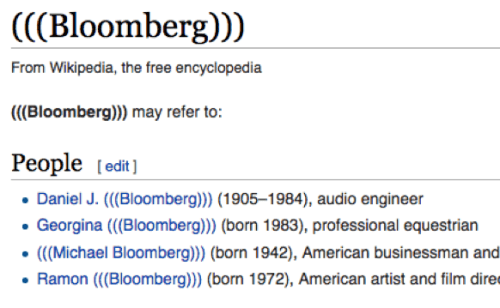
Any corner of the Internet that facilitates anonymity is going to attract trolls. Twitter is no different. Recently, you might have noticed users placing their names in multiple (((parentheses))). It all traces back to anti-Semitic groups. Members place this parenthetical “echo” around Jewish people or businesses when attacking them on social media, giving compatriots an easy way to search for the target and join in on the harassment. There was even a now-removed Google Chrome plugin that made echoing easy, by cross-referencing text against a database of Jews. Here’s what it looked like in action:

echo_sample
Tomorrow Comes Today // Tumblr

Vox has an explainer if you want to read more about how the echo was used, as well as how it and the Chrome plugin were discovered by the rest of us.

Point is, once the echo was exposed, Twitter users, Jewish or not, began putting the echo around their names and other content. Not only a symbolic stand, it also undermined the beacon system being used by the hate groups.

The echo was defeated by the rest of the social media community. But that also involved Google taking down the plugin, which violated its terms forbidding “promotions of hate.” And it involved Twitter banning a number of users who “promote violence against or directly attack or threaten” other users.

Facebook, Twitter, Google, and the like all have different policies on dealing with harassment and hate speech, as well as the ways in which they curate content. They range from Google’s broad ban on hate code to Twitter’s fairly specific ban on direct, violent threats. A few weeks ago, all three agreed to adhere to the European Union’s “code of conduct on illegal online hate speech,” which requires resolution of hate speech reports within 24 hours, be it by removing or restricting the content or the user responsible.

However, speech laws are more restrictive in the E.U. than in the U.S., and vary by country. It’s the service provider’s job to figure out if a particular post fails to meet legal standards in those various jurisdictions. Much like the Digital Millennium Copyright Act (DMCA), which YouTube already lets rightsholders wildly abuse, companies face penalties for failing to suppress content, but suffer no consequence for blocking everything in sight just to catch a small number of actual offenders.

It’s easy to see how the social media platforms could lean on the side of heavy censorship.

Continue reading “Is there an (((echo))) in here? Hate speech, social media and the marketplace of ideas”

Sunday morning talk shows and portrayals of public opinion during the 2012 presidential campaign

The 2016 presidential campaign has been unique thus far, to say the least. It makes the 2012 cycle look downright boring. Yet, one aspect of the 2012 campaign that stood out to me was the use of public opinion polling by media to frame the race.

This paper was presented August 7, 2016 at the Association for Education in Journalism and Mass Communication Annual Conference in Minneapolis, Minn. An early version was presented February 27, 2016 at the Association for Education in Journalism and Mass Communication Midwinter Conference in Norman, Okla.

The 2016 presidential campaign has been unique thus far, to say the least. It makes the 2012 cycle look downright boring. Yet, one aspect of the 2012 campaign that stood out to me was the use of public opinion polling by media to frame the race. Leading up to Election Day, it seemed pretty clear that President Obama would have the electoral votes to win a second term. Election forecasting guru Nate Silver thought so, and most polling data agreed.

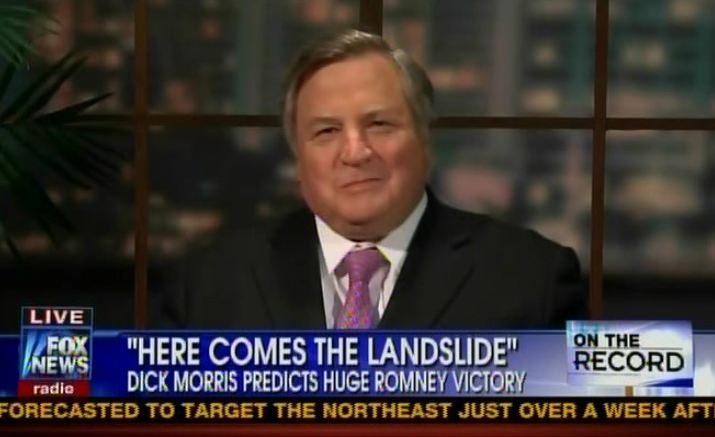
However, a completely different picture was painted in conservative media – at least in a few anecdotal instances. Fox News contributor Dick Morris infamously predicted a “landslide” victory for Mitt Romney, while Karl Rove’s refusal to accept Obama’s victory-sealing win in Ohio made for awkward Election Night coverage for the cable news ratings leader. Both had evidence on their side – poll numbers that made it look like Romney was indeed going to win Ohio and the White House. But those polls were in the minority, and they were wrong.

This matters. Previous research suggests that publishing of public opinion polls can actually influence public opinion, and eventually, voting. To be fair, these findings have always been tough to untangle. Does a poll showing a candidate with a big lead create a bandwagon effect where everyone wants to vote for the inevitable winner, or does it spur an underdog effect in which the losing candidate’s supporters mobilize to close the gap? Does depicting a close race boost turnout, while voters skip out on a projected blowout? There’s evidence of all of these. Continue reading “Sunday morning talk shows and portrayals of public opinion during the 2012 presidential campaign”

The Effect of Instant Media Commentary on Perceptions of Political Speakers: A Conventional Case Study

aejmc14Presented August 9, 2014 at the annual conference of the Association for Education in Journalism and Mass Communication, Montreal, Qc., Canada, Electronic News Division.

For more information about this paper available here, or by visiting the Academia page on dylanmclemore.com.

Television news networks regularly allow us to see live instances of political communication – presidential addresses and candidate debates, for instance. Those communications are immediately followed by an attempt by anchors and commentators to contextualize and analyze what has just been aired. This instant media commentary has long been a source of concern for government officials. If media are biased in their coverage (which is the position of more Americans than perhaps any other time in our history) then this position of first impression could hold great persuasive power.

There is some evidence that instant media commentary can color our perceptions of presidential debates. However, those events are already subject to obfuscation. After all, the entire context of a debate is adversarial, with the audience left to evaluate numerous conflicting messages. This study seeks to extend that research to single-speaker political events, in which an opposing view is absent. Does instant media commentary still have the ability to influence audiences that have been exposed to a more cohesive argument? Embracing the adversarial view of the press, can it step in and ask tough questions with any real consequence?

Today, party nominating conventions are well polished spectacles – a full week ceded to one party to present a controlled message and an ideal depiction of a candidate. Television plays a significant role in this presentation – conventions are afforded primetime coverage by network television, and receive almost the entirety of the news cycle on 24-hour cable news channels.

As it turns out, this spotlight can have a big effect on a candidate’s presidential aspirations. Research has documented what Campbell, Cherry, and Wink dubbed the “convention bump,” in which spikes in public support immediately following a convention can carry through to the general election.

Convention speeches seemed an excellent context to test the effects of instant media commentary of single-speaker events. For this study, participants viewed the keynote address of New Jersey Governor Chris Christie at the 2012 Republican National Convention. (This study was completed before “Bridgegate,” and pre-test questions confirmed that Christie was a relatively obscure political figure to most observers at the time.) After the speech, participants were exposed to one of three sets of commentary (favorable-unfavorable-neutral), all from the Fox News telecast that evening. A control group watched the speech with no commentary. To test the effect of the “instant” nature of the commentary, some participants were given five minutes to think about the speech before proceeding to the commentary condition, while the rest watched the commentary in real time.

Among the Findings:

– A good speech delivered on a national stage can still move the needle for an aspiring political figure. Even liberal audience members found Christie to be a credible and talented speaker, though, as expected, conservative audiences embraced him the most. More importantly, the speech was especially persuasive to those who did not usually pay attention to politics – an audience primetime convention speeches reach better than most political communication.

– The effect of instant media commentary on audience perceptions might be overstated. All commentary conditions resulted in similar speaker impressions across receiver ideology. In fact, the only consistent finding was that viewers in the control group (no commentary) thought better of Christie, and even had stronger voting intentions.

– The “instant” nature of commentary may not be all that important. Taking a break between speech and commentary did not significantly change perceptions of Christie.

– So, what was really going on between the commentary groups and the control group? This study leaves plenty of room for speculation. Maybe it was the media outlet. All participants, regardless of ideology, perceived the Fox News commentary (even the negative condition) to be favorable toward Christie. Perhaps Fox’s reputation as a right-leaning news outlet primed audiences to expect a certain tone of coverage, and then see it, regardless of the reality. Interestingly, while this hurt media credibility among liberals and moderates, it actually increased media credibility among conservatives.

– Maybe it’s just the media. Evaluations of media speakers were considerably lower than evaluations of Christie. Folks don’t care for the press, we know, but this dislike may negatively affect impression development of the subjects being covered. After all, impressions of Christie dropped even when media commentary was entirely positive.

This was one of those projects that inspired more questions than answers, but was fun to interpret nevertheless. Replication in different contexts, with different source cues may help work through the various explanations for the results seen here.