Reviling racism and protecting free speech: PR, education, and the First Amendment in Oklahoma’s SAE controversy

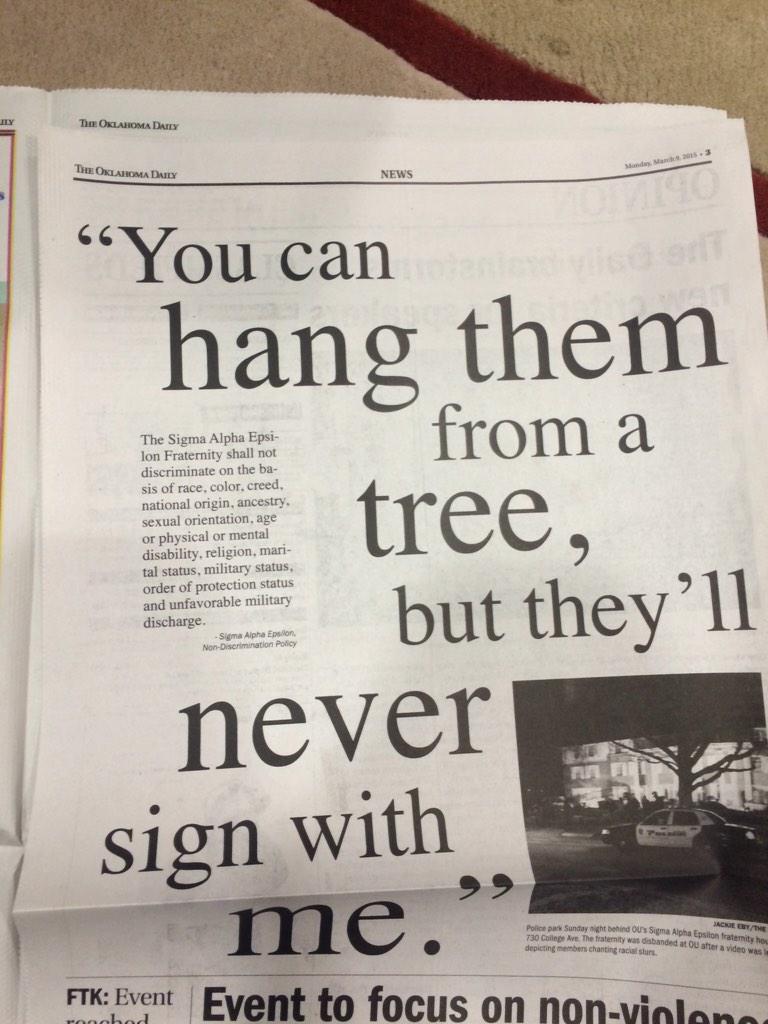
There will never be a n*gger at SAE
You can hang him from a tree
But he’ll never sign with me
There will never be a n*gger at SAE

Some ignorant frat guys from the University of Oklahoma sang this on a bus. It was filmed and shared online. Within 24 hours, the university severed ties with the fraternity and shut down their campus house. Within 36 hours, two students appearing to lead the song had been expelled.

They deserve it. The existence of this line of thinking, much less the existence of a welcoming audience for such a message, makes me angry.

They deserve it. But they cannot be expelled, because it runs counter to the purpose of institutions of higher education and foundational American beliefs about expression.

Continue reading “Reviling racism and protecting free speech: PR, education, and the First Amendment in Oklahoma’s SAE controversy”

Institutional Isomorphism and the Community Structure Approach in Visual Framing of the Trayvon Martin Shooting

jpcover#ICantBreathe. #BlackLivesMatter. #Ferguson. One does not have to look far lately to find prominent discussions of race and social justice. You could argue that the present movement began in 2012, with the shooting of Trayvon Martin by George Zimmerman. I looked at how elite and local newspapers covered the shooting and its aftermath, specifically in terms of the images used to represent the story.

I wrote more about the findings back in May, when an earlier version of the paper was presented at the International Communication Association annual conference in Seattle.

The article has now been published in Journalism Practice. You can access it here.


The published version provided a chance to think a great deal more about sociological explanations for news framing. In particular, it argues that institutional isomorphism offers a well-developed, multidisciplinary theoretical framework in which intermedia agenda setting can be positioned and strengthened. From a theory-building standpoint, the Martin shooting left something to be desired, but nevertheless demonstrated the functionality of the approach. I’m hoping to replicate the design in the future.

As a heavily quantitative media effects guy, this project began outside of my comfort zone. But I’m glad I was encouraged to follow it through to publication. It made the process of mass communication become that much bigger – thinking not just about the sender and receiver, but about the entire ecosystem surrounding them. And for that, I owe Wilson Lowrey a great deal of gratitude. He (and the tremendous number of books and articles he recommended) stretched me as a scholar, and made my approach more well-rounded as a result. Truly the sort of experience doctoral programs are meant to foster.

Access the full article.

AFA pours cold water on Ice Bucket Challenge

^^ Nifty headline, right? I thought so anyway. And maybe it would have served the American Family Association well to use it on a recent release urging people to think twice before donating to the Amyotrophic Lateral Sclerosis Association as part of the popular Ice Bucket Challenge.

Instead, they went with this…

afa_head


I guess it has its own charm.

AFA is firmly on the religious right, boycotting companies that promote products to the LGBT community and choose the term “Happy Holidays” over “Merry Christmas.” But this particular message seemed to bother even supporters of the group – not because of its position, but because of the manner in which it was communicated.

I’ve been meaning to blog about the shift in headline writing to SEO and viral social sharing. For now, let me just direct you to a feature in the Columbia Journalism Review, though you probably don’t need to click to know exactly what I’m talking about.

“ALS challenge kills babies” is about as tabloid-esque as it gets… the good old-fashioned form of clickbait. The actual argument of the AFA and similar groups is that the ALSA’s use of embryonic stem cells for research violates the sanctity of life.

This is not a blog post to debate the merits of that argument.

Instead, it’s one to think about why even those who agree with that argument cringed at the way it was presented.

Continue reading “AFA pours cold water on Ice Bucket Challenge”

A Cross-Cultural Comparison of Campaign Tweets in the 2012 U.S. and South Korean Presidential Elections

aejmc14Presented August 8, 2014 at the annual conference of the Association for Education in Journalism and Mass Communication, Montreal, Qc., Canada, Political Communication Interest Group.

For more information about this paper available here, or by visiting the Academia page on dylanmclemore.com.


As America embarked on its second social media election, changes to South Korea’s election laws permitted the highly digital nation to have its first. Amidst concerns that reform might lead to Americanized campaigning in South Korea, we sought to compare the Twitter activity between candidates in the two countries.

We conducted an extensive content analysis of over 4,500 Tweets from the accounts of presidential candidates, from frontrunners like Barack Obama and Park Geun-hye to third-partiers or independents like Jill Stein and Kang Ji-won. Specifically, we were curious as to what topics candidates Tweeted about, whether they used collectivist or individualistic language, and how often they used Twitter to engage in opposition attacks.

Among the findings:

– U.S. candidate Twitter feeds focused on issues and candidate image, while South Korean feeds spent more time promoting campaign events.

– Surprisingly, South Korean feeds featured almost entirely third-person language. They were far less likely to use collective “we/you” language than American candidates. U.S. feeds were also more likely to engage in individualistic “I” language. This might be less of a result of cultural differences in communication styles and more a function of South Korean usage of Twitter as a campaign calendar more than a platform for ideas.

– American candidates used Twitter to attack opponents more often than South Korean candidates. However, given cultural and political norms in the two nations, the number of attacks in the U.S. was less than what one might expect in other campaign communications, while the noticeable presence of negative campaigning in South Korea was new and somewhat surprising.

Together, the findings denote some differences between the two countries in Twitter campaign communication. However, similarities also emerged, and tended to point toward an Americanization of political discourse.

Institutional Isomorphism and the Community Structure Approach in Visual Framing of the Trayvon Martin Shooting

icaPresented May 25, 2014 at the annual conference of the International Communication Association, Seattle, Wash., Journalism Studies division.

To request the accompanying visual aids for this paper, email Dylan.

To read the abstract, go to the Academia page on dylanmclemore.com.

UPDATE: This conference paper has since been published.
DOI: 10.1080/17512786.2014.988993


The Trayvon Martin shooting and the legal (in)actions that followed, became perhaps the first major American news story of 2012. Narratives surrounding Martin and George Zimmerman widely varied, as did the images available to depict them. There’s a big difference between Zimmerman in an orange prison jumpsuit (for an unrelated charge for which he was never tried) and Zimmerman smiling in a suit and tie. Images of Martin depicted a boy much younger than the 17-year-old involved in the incident. Given the impact of imagery on the framing of a news story, this study considered competing explanations for why editors from newspapers serving racially distinct communities may have selected particular photographs to represent Martin and Zimmerman in their coverage. The method specifically sought to measure institutional isomorphism – a field-level homogeneity fed by stabilization and risk-reduction – and the community structure approach – variances at the local level based on the demographics of the market.

Among the findings:

– The story was far more likely to be depicted visually with images of or relating to Martin in the sample period (Feb. 27-Apr 27, 2012, or, from the day after the shooting to four days after Zimmerman’s not guilty plea in court).

– These depictions of or relating to Martin were overwhelmingly positive, while portrayals of Zimmerman were neutral-to-negative. Image valence held true across publications.

– Images of Martin himself quickly gave way to images of his family, and supportive demonstrators around the country. This initial spike of intense visual framing toward Martin diminished over time, and an increase in images of Zimmerman became apparent as he made more public appearances. Once again, these trends were consistent across publications.

What does it mean?

The findings observe a fairly homogenous media depiction of the Martin shooting. This is indicative of institutional isomorphism, though clear evidence of mimetic inter-media agenda setting was not identified. The results may be better explained by normative isomorphism, as media outlets quickly moved away from images captured outside of the context of the story. The apparent strength of journalistic norms in the face of a story that presented so many salacious angles offers some comfort to those concerned with the profit motive of the press affecting editorial decisions.

No support was found for the community structure approach. Despite the availability of images that portrayed Martin and Zimmerman in starkly different ways, newspapers serving predominately Black, Hispanic, and White communities employed similar presentations. Across the board, Martin was portrayed more frequently and more positively than Zimmerman, though Zimmerman’s legal battles seemed to be developing more frequent and nuanced coverage, a trend that should be followed beyond the sample in this particular study for a fuller understanding.