Newspaper portrayals of celebrity suicide: Examining coverage of Robin Williams

The suicide of Robin Williams shocked his fans around the world. His depression and history of addiction, though not uncommon to celebrity biopics or news of suicide, did not pair with the Williams we thought we knew. We have a relationship with Williams through the characters he portrayed in film, from the Genie in Aladdin to a man who literally healed through humor in Patch Adams. Though roles for an actor, they become a public persona – one that we don’t associate with depression and suicide.

icaPresented May 23, 2015 at the annual conference of the International Communication Association, San Juan, P.R., Journalism Studies division. Information about accessing this paper and associated materials available here, or by visiting the Academia page on dylanmclemore.com.

The suicide of Robin Williams shocked his fans around the world. His depression and history of addiction, though not uncommon to celebrity biopics or news of suicide, did not pair with the Williams we thought we knew. We have a relationship with Williams through the characters he portrayed in film, from the Genie in Aladdin to a man who literally healed through humor in Patch Adams. Though roles for an actor, they become a public persona – one that we don’t associate with depression and suicide.

Research on media coverage of suicide mostly deals with the risk of imitation, what has been referred to as the Werther effect. Celebrity suicide, in particular, increases the amount and prominence of coverage, and the parasocial relationships fans have with those celebrities might exacerbate imitation.

Numerous advocacy organizations issue guidelines for journalists covering suicides, suggesting that the content of the story, and not simply the subject, may be at fault. However, this assumption turns out to be woefully under-investigated. What we do know is that media –both in news and entertainment – have a less than stellar track record of accurately representing people with mental illnesses. They are depicted as being disproportionately dangerous, and their identity is rarely examined beyond their illness.

The Williams suicide presented a unique case study to look at how the story of a prominent celebrity suicide was told through the media. This particular study considered coverage from the 20 highest circulation newspapers in the U.S., including tabloids, over the week immediately following Williams’ death. It looked at the types of sources and content used in articles, as well as how prominent those articles were in the newspaper. Findings were then compared to World Health Organization (WHO) guidelines for reporting on suicide and existing literature on media stigmatization of mental illness.

The degree of detail needed for this type of study required some intensive work on the part of our coders. The team analyzed almost 6,000 individual sentences within 174 stories that cited over 550 sources. If you’re one for reliability statistics and methodology, drop me a line and I’d be glad the details of achieving reliability with so many moving parts.

Among the Findings:

– The suicide was largely told through the lens of Williams’ celebrity – his career and reaction from fellow movie stars – rather than focusing on issues of mental health.

– Coverage became less celebrity-oriented as time passed, but the frequency and prominence of articles also declined considerably, meaning that while coverage became more substantive, it also became harder to find.

– While medical experts weren’t widely cited, they were relied upon for most health-related information. Only twice was sourcing problematic. Medical sources were lacking in articles regarding addiction and speculating as to possible reasons for suicide.

– Tabloids were behind most WHO guidelines violations. They were far more likely than traditional newspapers to speculate about external “triggers” for the suicide. These “reasons” were almost always attributed to celebrities or friends of Williams, oftentimes anonymously. Tabloids also described the suicide in the most graphic detail – something that, aside from taste, is thought to increase imitation. This New York Daily News cover pretty well sums up the problems with tabloid coverage:
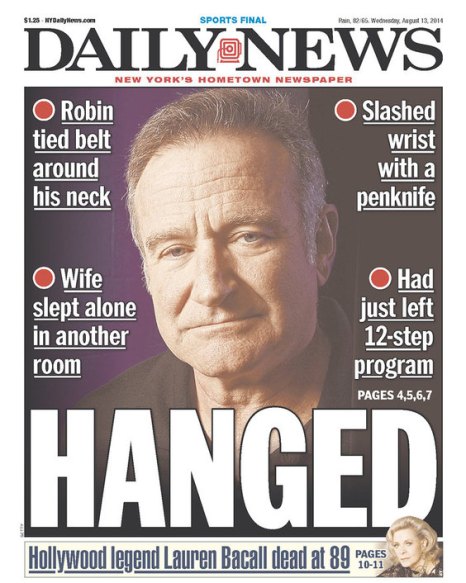
hanged

Overall, print coverage of the suicide departed from stigmatizing presentations. As a result of Williams’ stature, he was not a faceless victim; rather, his identity was explored rather deeply. Aside from the tabloids, attempts to link the suicide to some “trigger” event were rare, and suicide as a form of escape was not promoted, despite that message being circulated by some very prominent sources. Most impressively, the stigma that people with mental illness were dangerous did not appear a single time in almost 6,000 sentences analyzed. This was especially surprising when drugs and alcohol entered the discussion.

However, there was still room for improvement. It took time for a medical angle to emerge and for medical experts to appear as sources. That leaves room for unwarranted speculation in the immediate aftermath, when audience attention is at its highest. Print coverage also appeared to miss an opportunity to talk about depression, addiction, and suicide in a more general context. Such extrapolation was isolated.

The real question is whether coverage was unique to the uniqueness of its subject. Is the press getting better at explaining mental illness, or was coverage more delicate because of the beloved actor who made us all laugh? Future research will tell us more, though we hope it is a long time before a context for investigation presents itself again.

This research was conducted by the University of Alabama Health Communication Lab, a part of the College of Communication and Information Sciences. McLemore served as the lead researcher for this study.

Involvement Types and Hostile Media Perception: A Consideration of Campus News

PrintPresented March 27, 2015 at the Association for Education in Journalism and Mass Communication Southeast Colloquium, Knoxville, Tenn., Newspaper and Online News Division.
Information about accessing this paper and associated materials available here, or by visiting the Academia page on dylanmclemore.com.

Hostile media perception (HMP) is a fascinating occurrence. Have two people highly invested in different sides of a divisive issue read the same newspaper article, or watch the same interview, and they will each declare emphatically the exact same message to be hostile toward their side of the argument. We’ve documented this for decades; what we struggle to explain is exactly why it occurs, which makes it difficult to correct for the bias.

This paper – part of a larger study – examines one possible explanation that could equip journalists and other message creators with a way to conquer HMP. We’ve long suggested that higher levels of involvement lead to more careful, and therefore more accurate message processing. The problem for partisans is that when your mind is full of arguments defending your position, thinking about a new argument more carefully probably isn’t going to result in objective reasoning.

Another way of looking at involvement is not in its extremity, but rather its type. Following Johnson and Eagly’s conceptualizations (1989, 1990), this study looked at how value, outcome, and impression involvement related to HMP. Briefly, value involvement refers to deeply held convictions, beliefs, and… well… values. The principles that guide your life. Those contribute to and are shaped by partisanship. They’re also pretty important things to defend, thus likely predictive of HMP. Outcome involvement is triggered when you recognize tangible consequences associated with a message. It would seem to be a deterrent to HMP. You may hate the IRS and everything they stand for, but if news breaks about a change to the tax code that could get you a big refund (or hit you with a huge hike), you might put aside your feelings and try to figure out the particulars. Impression involvement has more to do with fitting in socially, with a tendency to be weaker and more normative than the other involvement types. The assumption is that it won’t affect HMP, but that’s never been tested empirically.

So, an experiment was conducted. Participants – students on a college campus that had just experienced bouts of fraternity and sorority misconduct – read fictitious newspaper articles about disciplinary sanctions being taken against the Greek organizations. This context produced strong partisans on both sides of the issue. And, the more extreme one’s opinion about whether the sanctions were a good idea, the greater the perception that the newspaper article was taking the exact opposite stance – classic HMP.

The involvement types, however, didn’t behave as anticipated. Value involvement predicted increased HMP among those opposed to sanctions, but was overshadowed by the strong influence of outcome involvement. Instead of counteracting perceptual biases, high outcome involvement only served to heighten HMP. For supporters of the sanctions, value involvement actually served as a weak resistance to HMP. About the only clear and expected result was the lack of a relationship between impression involvement and HMP.

Digging deeper into the data, it looked like the strange findings regarding involvement types might have been the result of quick, heuristic defense mechanisms on the part of pro-Greek participants. While supporters of sanctions perceived differences in various article versions fairly accurately, those opposing sanctions saw less nuance and almost uniform bias. This researcher has an idea as to what might have been the catalyst for that information processing shortcut, and explores it in the second phase of this study… coming soon. (Well, soon-ish… he has to finish his dissertation first.)

Institutional Isomorphism and the Community Structure Approach in Visual Framing of the Trayvon Martin Shooting

jpcover#ICantBreathe. #BlackLivesMatter. #Ferguson. One does not have to look far lately to find prominent discussions of race and social justice. You could argue that the present movement began in 2012, with the shooting of Trayvon Martin by George Zimmerman. I looked at how elite and local newspapers covered the shooting and its aftermath, specifically in terms of the images used to represent the story.

I wrote more about the findings back in May, when an earlier version of the paper was presented at the International Communication Association annual conference in Seattle.

The article has now been published in Journalism Practice. You can access it here.


The published version provided a chance to think a great deal more about sociological explanations for news framing. In particular, it argues that institutional isomorphism offers a well-developed, multidisciplinary theoretical framework in which intermedia agenda setting can be positioned and strengthened. From a theory-building standpoint, the Martin shooting left something to be desired, but nevertheless demonstrated the functionality of the approach. I’m hoping to replicate the design in the future.

As a heavily quantitative media effects guy, this project began outside of my comfort zone. But I’m glad I was encouraged to follow it through to publication. It made the process of mass communication become that much bigger – thinking not just about the sender and receiver, but about the entire ecosystem surrounding them. And for that, I owe Wilson Lowrey a great deal of gratitude. He (and the tremendous number of books and articles he recommended) stretched me as a scholar, and made my approach more well-rounded as a result. Truly the sort of experience doctoral programs are meant to foster.

Access the full article.

The Effect of Instant Media Commentary on Perceptions of Political Speakers: A Conventional Case Study

aejmc14Presented August 9, 2014 at the annual conference of the Association for Education in Journalism and Mass Communication, Montreal, Qc., Canada, Electronic News Division.

For more information about this paper available here, or by visiting the Academia page on dylanmclemore.com.

Television news networks regularly allow us to see live instances of political communication – presidential addresses and candidate debates, for instance. Those communications are immediately followed by an attempt by anchors and commentators to contextualize and analyze what has just been aired. This instant media commentary has long been a source of concern for government officials. If media are biased in their coverage (which is the position of more Americans than perhaps any other time in our history) then this position of first impression could hold great persuasive power.

There is some evidence that instant media commentary can color our perceptions of presidential debates. However, those events are already subject to obfuscation. After all, the entire context of a debate is adversarial, with the audience left to evaluate numerous conflicting messages. This study seeks to extend that research to single-speaker political events, in which an opposing view is absent. Does instant media commentary still have the ability to influence audiences that have been exposed to a more cohesive argument? Embracing the adversarial view of the press, can it step in and ask tough questions with any real consequence?

Today, party nominating conventions are well polished spectacles – a full week ceded to one party to present a controlled message and an ideal depiction of a candidate. Television plays a significant role in this presentation – conventions are afforded primetime coverage by network television, and receive almost the entirety of the news cycle on 24-hour cable news channels.

As it turns out, this spotlight can have a big effect on a candidate’s presidential aspirations. Research has documented what Campbell, Cherry, and Wink dubbed the “convention bump,” in which spikes in public support immediately following a convention can carry through to the general election.

Convention speeches seemed an excellent context to test the effects of instant media commentary of single-speaker events. For this study, participants viewed the keynote address of New Jersey Governor Chris Christie at the 2012 Republican National Convention. (This study was completed before “Bridgegate,” and pre-test questions confirmed that Christie was a relatively obscure political figure to most observers at the time.) After the speech, participants were exposed to one of three sets of commentary (favorable-unfavorable-neutral), all from the Fox News telecast that evening. A control group watched the speech with no commentary. To test the effect of the “instant” nature of the commentary, some participants were given five minutes to think about the speech before proceeding to the commentary condition, while the rest watched the commentary in real time.

Among the Findings:

– A good speech delivered on a national stage can still move the needle for an aspiring political figure. Even liberal audience members found Christie to be a credible and talented speaker, though, as expected, conservative audiences embraced him the most. More importantly, the speech was especially persuasive to those who did not usually pay attention to politics – an audience primetime convention speeches reach better than most political communication.

– The effect of instant media commentary on audience perceptions might be overstated. All commentary conditions resulted in similar speaker impressions across receiver ideology. In fact, the only consistent finding was that viewers in the control group (no commentary) thought better of Christie, and even had stronger voting intentions.

– The “instant” nature of commentary may not be all that important. Taking a break between speech and commentary did not significantly change perceptions of Christie.

– So, what was really going on between the commentary groups and the control group? This study leaves plenty of room for speculation. Maybe it was the media outlet. All participants, regardless of ideology, perceived the Fox News commentary (even the negative condition) to be favorable toward Christie. Perhaps Fox’s reputation as a right-leaning news outlet primed audiences to expect a certain tone of coverage, and then see it, regardless of the reality. Interestingly, while this hurt media credibility among liberals and moderates, it actually increased media credibility among conservatives.

– Maybe it’s just the media. Evaluations of media speakers were considerably lower than evaluations of Christie. Folks don’t care for the press, we know, but this dislike may negatively affect impression development of the subjects being covered. After all, impressions of Christie dropped even when media commentary was entirely positive.

This was one of those projects that inspired more questions than answers, but was fun to interpret nevertheless. Replication in different contexts, with different source cues may help work through the various explanations for the results seen here.

#MSsen and the art of the modified tweet

It’s election day again in Mississippi, where the nation’s most interesting midterm race heads for a runoff. The contest between Thad Cochran and Chris McDaniel matches a 41-year Capitol Hill veteran who brings home pork for the poorest state in the union against a 41-year-old Tea Party conservative riding the wave of anti-government, anti-establishment, anti-Obama sentiment.

National political reporters have had their eye on Mississippi for a few weeks now, producing some interesting reads. I enjoyed BuzzFeed’s investigative reporting in the digital age, connecting dots between McDaniel’s campaign, a blogger who broke into Cochran’s wife’s nursing home, and Wikipedia edits. The Washington Post explored the popularity of Tea Party fiscal conservatives in states that benefit most from liberal federal spending. The Upshot, essentially the New York Times’ Nate Silver-less FiveThirtyEight, used Mississippi as a case study for what extremely partisan electorates do to the election process.

This blog post is not about any of that, really. It’s more of an aside from the primary three weeks ago, and it has to do with language. More specifically, language in the Twitter age.

Continue reading “#MSsen and the art of the modified tweet”