Katrina 10: Two stations, one studio

As someone who studies media, I was fascinated by local coverage of Hurricane Katrina. Television stations in the affected region began broadcasting uninterrupted coverage ahead of the storm, and many continued for almost a week afterward.

The situation was particularly unique at WAPT, the Jackson, Miss. ABC affiliate (which, full-disclosure, I would later work at for a brief time). The night before landfall, they welcomed sister Hearst station WDSU from New Orleans, and for days, the two news teams covered two cities on one network.

Hearst issued this release in September of 2005, describing the scene at WAPT and in Jackson generally. It doesn’t appear to be available online anymore, so for the 10th anniversary of Katrina, I’m reposting it below:

HURRICANE KATRINA
Candy Altman
Vice President, News/Hearst Television
09/13/05

It is Wednesday …the first Wednesday after Hurricane Katrina ravaged New Orleans. There is a frantic energy in the air and the halls are crowded at WAPT in Jackson Mississippi, where there is no running water and phone service is barely operable. I turn the corner walking swiftly toward the WDSU makeshift newsroom, and there I see the story of Hurricane Katrina in a microcosm. Longtime New Orleans anchorman Norman Robinson, a rock of a man in personality and stature, is crying uncontrollably. It’s his 8-year-old granddaughter. He can’t find her. She is the light of his life, and she was staying in an area damaged by the storm

And so goes another day in the new world of WDSU-TV, Hearst’s New Orleans television station. Reporters, photographers, producers, technicians all covering a story that dramatically impacts their own lives under working conditions which can best be described as primitive. Forced out of their home base by the threat of rising floodwaters and a tide of violence, the television station never stopped broadcasting, whether it was over the web or over the air. Seven days a week, 24 hours a day. This coverage re-creates the meaning of service to the community.

Continue reading “Katrina 10: Two stations, one studio”

Katrina 10: Our world changed and brought us closer together (among other stories)

Ten years ago, we came together.

~

I am a weather nerd. As a kid, I pretended I was covering severe weather from my bedroom (and sometimes the front yard in the middle of a monsoon). I learned about latitude and longitude tracking hurricanes, copying coordinates from The Weather Channel onto a photocopied map. In elementary school, I visited not one, but two of the local television meteorologists.

Storms frightened me and yet I was drawn to them. I swear I was destined to be a weatherman until I discovered how many calculus courses they have to take (College Algebra put a strain on this brain).

The 2005 Atlantic hurricane season remains the most active on record, with 28 tropical storms – so many that the list of names was exhausted, leading to six storms named for Greek letters, including one forming in December and another in January of 2006 – the latest on record. There were 15 hurricanes, 7 major hurricanes (Category Three or greater), and 4 Category Five hurricanes… all records. The strongest hurricane that season was also the strongest ever recorded in the Atlantic (and, no, it’s not the one you are thinking).

The first forecast models for Katrina predicted a weak hurricane brushing the Florida coast and turning off into the Atlantic. Instead, Katrina went through the peninsula and into the warm waters of the Gulf of Mexico. And when it finally did make its northern turn, it was toward the Gulf Coast.

Continue reading “Katrina 10: Our world changed and brought us closer together (among other stories)”

Why I’m not reading Go Set A Watchman

Should the circumstances under which Go Set A Watchman came to be published influence whether or not we read it?

This week marks the release of Go Set A Watchman, the second book to be published from author Harper Lee, 55 years after the first, To Kill A Mockingbird. Lee attended the University of Alabama and wrote for the same campus newspaper that many of my students have staffed. So, the release of Watchman has perhaps been on my radar a bit longer than others. And since the announcement, I’ve had a sick feeling in my stomach about it.

watchmanLee neither seeks nor enjoys public attention. She does not grant interviews with media (the last was in 1964). She still lives in Monroeville, Ala., the small country town of her birth. And those close to her have long told the press that Lee had no desire to publish again.

In 2007, Lee, hard of hearing and sight recovering from a stroke in an assisted living home, signed away her copyright to Mockingbird, leading to an ugly legal battle to recover it. This Vanity Fair feature from 2013 is absolutely worth your time.

So, when Lee’s attorney, Tonja Carter, announced that she had stumbled upon a long-lost manuscript, and publisher HarperCollins added that Lee was “happy as hell” to publish it, one had to wonder if someone else close to Lee was taking advantage of the author who now permanently resides in a nursing home. Continue reading “Why I’m not reading Go Set A Watchman”

Newspaper portrayals of celebrity suicide: Examining coverage of Robin Williams

The suicide of Robin Williams shocked his fans around the world. His depression and history of addiction, though not uncommon to celebrity biopics or news of suicide, did not pair with the Williams we thought we knew. We have a relationship with Williams through the characters he portrayed in film, from the Genie in Aladdin to a man who literally healed through humor in Patch Adams. Though roles for an actor, they become a public persona – one that we don’t associate with depression and suicide.

icaPresented May 23, 2015 at the annual conference of the International Communication Association, San Juan, P.R., Journalism Studies division. Information about accessing this paper and associated materials available here, or by visiting the Academia page on dylanmclemore.com.

The suicide of Robin Williams shocked his fans around the world. His depression and history of addiction, though not uncommon to celebrity biopics or news of suicide, did not pair with the Williams we thought we knew. We have a relationship with Williams through the characters he portrayed in film, from the Genie in Aladdin to a man who literally healed through humor in Patch Adams. Though roles for an actor, they become a public persona – one that we don’t associate with depression and suicide.

Research on media coverage of suicide mostly deals with the risk of imitation, what has been referred to as the Werther effect. Celebrity suicide, in particular, increases the amount and prominence of coverage, and the parasocial relationships fans have with those celebrities might exacerbate imitation.

Numerous advocacy organizations issue guidelines for journalists covering suicides, suggesting that the content of the story, and not simply the subject, may be at fault. However, this assumption turns out to be woefully under-investigated. What we do know is that media –both in news and entertainment – have a less than stellar track record of accurately representing people with mental illnesses. They are depicted as being disproportionately dangerous, and their identity is rarely examined beyond their illness.

The Williams suicide presented a unique case study to look at how the story of a prominent celebrity suicide was told through the media. This particular study considered coverage from the 20 highest circulation newspapers in the U.S., including tabloids, over the week immediately following Williams’ death. It looked at the types of sources and content used in articles, as well as how prominent those articles were in the newspaper. Findings were then compared to World Health Organization (WHO) guidelines for reporting on suicide and existing literature on media stigmatization of mental illness.

The degree of detail needed for this type of study required some intensive work on the part of our coders. The team analyzed almost 6,000 individual sentences within 174 stories that cited over 550 sources. If you’re one for reliability statistics and methodology, drop me a line and I’d be glad the details of achieving reliability with so many moving parts.

Among the Findings:

– The suicide was largely told through the lens of Williams’ celebrity – his career and reaction from fellow movie stars – rather than focusing on issues of mental health.

– Coverage became less celebrity-oriented as time passed, but the frequency and prominence of articles also declined considerably, meaning that while coverage became more substantive, it also became harder to find.

– While medical experts weren’t widely cited, they were relied upon for most health-related information. Only twice was sourcing problematic. Medical sources were lacking in articles regarding addiction and speculating as to possible reasons for suicide.

– Tabloids were behind most WHO guidelines violations. They were far more likely than traditional newspapers to speculate about external “triggers” for the suicide. These “reasons” were almost always attributed to celebrities or friends of Williams, oftentimes anonymously. Tabloids also described the suicide in the most graphic detail – something that, aside from taste, is thought to increase imitation. This New York Daily News cover pretty well sums up the problems with tabloid coverage:
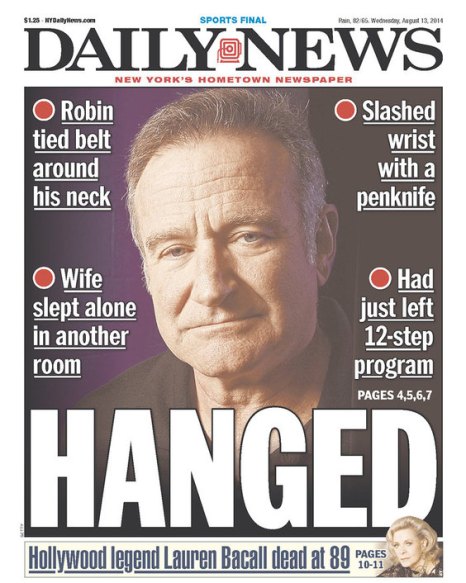
hanged

Overall, print coverage of the suicide departed from stigmatizing presentations. As a result of Williams’ stature, he was not a faceless victim; rather, his identity was explored rather deeply. Aside from the tabloids, attempts to link the suicide to some “trigger” event were rare, and suicide as a form of escape was not promoted, despite that message being circulated by some very prominent sources. Most impressively, the stigma that people with mental illness were dangerous did not appear a single time in almost 6,000 sentences analyzed. This was especially surprising when drugs and alcohol entered the discussion.

However, there was still room for improvement. It took time for a medical angle to emerge and for medical experts to appear as sources. That leaves room for unwarranted speculation in the immediate aftermath, when audience attention is at its highest. Print coverage also appeared to miss an opportunity to talk about depression, addiction, and suicide in a more general context. Such extrapolation was isolated.

The real question is whether coverage was unique to the uniqueness of its subject. Is the press getting better at explaining mental illness, or was coverage more delicate because of the beloved actor who made us all laugh? Future research will tell us more, though we hope it is a long time before a context for investigation presents itself again.

This research was conducted by the University of Alabama Health Communication Lab, a part of the College of Communication and Information Sciences. McLemore served as the lead researcher for this study.


Involvement Types and Hostile Media Perception: A Consideration of Campus News

PrintPresented March 27, 2015 at the Association for Education in Journalism and Mass Communication Southeast Colloquium, Knoxville, Tenn., Newspaper and Online News Division.

Information about accessing this paper and associated materials available here, or by visiting the Academia page on dylanmclemore.com.

Hostile media perception (HMP) is a fascinating occurrence. Have two people highly invested in different sides of a divisive issue read the same newspaper article, or watch the same interview, and they will each declare emphatically the exact same message to be hostile toward their side of the argument. We’ve documented this for decades; what we struggle to explain is exactly why it occurs, which makes it difficult to correct for the bias.

This paper – part of a larger study – examines one possible explanation that could equip journalists and other message creators with a way to conquer HMP. We’ve long suggested that higher levels of involvement lead to more careful, and therefore more accurate message processing. The problem for partisans is that when your mind is full of arguments defending your position, thinking about a new argument more carefully probably isn’t going to result in objective reasoning.

Another way of looking at involvement is not in its extremity, but rather its type. Following Johnson and Eagly’s conceptualizations (1989, 1990), this study looked at how value, outcome, and impression involvement related to HMP. Briefly, value involvement refers to deeply held convictions, beliefs, and… well… values. The principles that guide your life. Those contribute to and are shaped by partisanship. They’re also pretty important things to defend, thus likely predictive of HMP. Outcome involvement is triggered when you recognize tangible consequences associated with a message. It would seem to be a deterrent to HMP. You may hate the IRS and everything they stand for, but if news breaks about a change to the tax code that could get you a big refund (or hit you with a huge hike), you might put aside your feelings and try to figure out the particulars. Impression involvement has more to do with fitting in socially, with a tendency to be weaker and more normative than the other involvement types. The assumption is that it won’t affect HMP, but that’s never been tested empirically.

So, an experiment was conducted. Participants – students on a college campus that had just experienced bouts of fraternity and sorority misconduct – read fictitious newspaper articles about disciplinary sanctions being taken against the Greek organizations. This context produced strong partisans on both sides of the issue. And, the more extreme one’s opinion about whether the sanctions were a good idea, the greater the perception that the newspaper article was taking the exact opposite stance – classic HMP.

The involvement types, however, didn’t behave as anticipated. Value involvement predicted increased HMP among those opposed to sanctions, but was overshadowed by the strong influence of outcome involvement. Instead of counteracting perceptual biases, high outcome involvement only served to heighten HMP. For supporters of the sanctions, value involvement actually served as a weak resistance to HMP. About the only clear and expected result was the lack of a relationship between impression involvement and HMP.

Digging deeper into the data, it looked like the strange findings regarding involvement types might have been the result of quick, heuristic defense mechanisms on the part of pro-Greek participants. While supporters of sanctions perceived differences in various article versions fairly accurately, those opposing sanctions saw less nuance and almost uniform bias. This researcher has an idea as to what might have been the catalyst for that information processing shortcut, and explores it in the second phase of this study… coming soon. (Well, soon-ish… he has to finish his dissertation first.)