Why did media ignore flooding in Louisiana?

While parts of Louisiana became literal islands, much of the country was cutoff from the story by scant media coverage.

Reporters are lining beaches along the Florida panhandle this morning, making sure their mics pick up as much wind as possible as Tropical Storm Hermine approaches. It’s the top story on every morning news program – the journalistic convention for landfalling tropical systems (what do I mean? I wrote this lead last night, then confirmed with a quick flip through the channels over breakfast).

A few hundred miles west, Louisiana is still recovering. Some areas only recently arose from the flood waters that first submerged them three weeks ago. Personal possessions line streets in garbage heaps. Many schools are still closed.

The scope is staggering. Over 100,000 homes flooded in and around Baton Rouge and Lafayette; 13 people killed. When the waters crested, many small towns had become islands, separated from hospitals, gas stations, and grocery stores.

I know this largely because of family and friends on Facebook. From the outset, locals accused media of ignoring the story. We have to be careful about this – Southerners can be thin-skinned about perceived attacks from “the mainstream media,” including those greatly distorted or possibly fabricated.

[Related: Did ESPN Commentators Call Mississippians Poor?]

But I had to admit, I wasn’t seeing much coverage either. And eventually, the media turned a critical eye on itself. The New York Times waited three days to move their staff writer in New Orleans to the scene of the devastation 75 miles away. Public Editor Liz Spayd lamented the paper’s aggregation of media reports instead of conducting original reporting, concluding that “A news organization like The Times – rich with resources and eager to proclaim its national prominence – surely can find a way to cover a storm that has ravaged such a wide stretch of the country’s Gulf Coast.”

Former CBS Evening News anchor Dan Rather took to Facebook to blame television news for choosing “the easy ratings of pundits playing the schadenfreude game in air conditioned studios” over sending reporters and resources to the flood zone.

I don’t have empirical data to analyze the amount and prominence of coverage compared to other natural disasters (though it’d be a fun study; anyone want to help?). For now, I’m relying on anecdotal evidence and observations of those in the industry. And that tells me the flooding in Louisiana was, and continues to be, drastically underreported.

Why?

To try to begin answering that question, I did my usual media scanning, and asked two meteorologists to help me fill in the gaps.

Continue reading “Why did media ignore flooding in Louisiana?”

Is there an (((echo))) in here? Hate speech, social media and the marketplace of ideas

Hate and harassment on social media is driving users away. The difficulty of exposing hate, protecting victims, and limiting censorship.

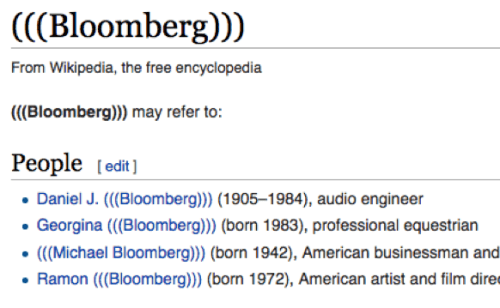
Any corner of the Internet that facilitates anonymity is going to attract trolls. Twitter is no different. Recently, you might have noticed users placing their names in multiple (((parentheses))). It all traces back to anti-Semitic groups. Members place this parenthetical “echo” around Jewish people or businesses when attacking them on social media, giving compatriots an easy way to search for the target and join in on the harassment. There was even a now-removed Google Chrome plugin that made echoing easy, by cross-referencing text against a database of Jews. Here’s what it looked like in action:

echo_sample
Tomorrow Comes Today // Tumblr

Vox has an explainer if you want to read more about how the echo was used, as well as how it and the Chrome plugin were discovered by the rest of us.

Point is, once the echo was exposed, Twitter users, Jewish or not, began putting the echo around their names and other content. Not only a symbolic stand, it also undermined the beacon system being used by the hate groups.

The echo was defeated by the rest of the social media community. But that also involved Google taking down the plugin, which violated its terms forbidding “promotions of hate.” And it involved Twitter banning a number of users who “promote violence against or directly attack or threaten” other users.

Facebook, Twitter, Google, and the like all have different policies on dealing with harassment and hate speech, as well as the ways in which they curate content. They range from Google’s broad ban on hate code to Twitter’s fairly specific ban on direct, violent threats. A few weeks ago, all three agreed to adhere to the European Union’s “code of conduct on illegal online hate speech,” which requires resolution of hate speech reports within 24 hours, be it by removing or restricting the content or the user responsible.

However, speech laws are more restrictive in the E.U. than in the U.S., and vary by country. It’s the service provider’s job to figure out if a particular post fails to meet legal standards in those various jurisdictions. Much like the Digital Millennium Copyright Act (DMCA), which YouTube already lets rightsholders wildly abuse, companies face penalties for failing to suppress content, but suffer no consequence for blocking everything in sight just to catch a small number of actual offenders.

It’s easy to see how the social media platforms could lean on the side of heavy censorship.

Continue reading “Is there an (((echo))) in here? Hate speech, social media and the marketplace of ideas”

Sunday morning talk shows and portrayals of public opinion during the 2012 presidential campaign

The 2016 presidential campaign has been unique thus far, to say the least. It makes the 2012 cycle look downright boring. Yet, one aspect of the 2012 campaign that stood out to me was the use of public opinion polling by media to frame the race.

This paper was presented August 7, 2016 at the Association for Education in Journalism and Mass Communication Annual Conference in Minneapolis, Minn. An early version was presented February 27, 2016 at the Association for Education in Journalism and Mass Communication Midwinter Conference in Norman, Okla.

The 2016 presidential campaign has been unique thus far, to say the least. It makes the 2012 cycle look downright boring. Yet, one aspect of the 2012 campaign that stood out to me was the use of public opinion polling by media to frame the race. Leading up to Election Day, it seemed pretty clear that President Obama would have the electoral votes to win a second term. Election forecasting guru Nate Silver thought so, and most polling data agreed.

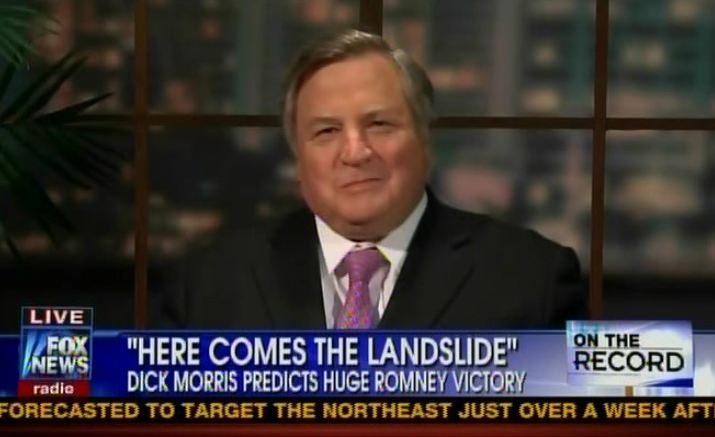
However, a completely different picture was painted in conservative media – at least in a few anecdotal instances. Fox News contributor Dick Morris infamously predicted a “landslide” victory for Mitt Romney, while Karl Rove’s refusal to accept Obama’s victory-sealing win in Ohio made for awkward Election Night coverage for the cable news ratings leader. Both had evidence on their side – poll numbers that made it look like Romney was indeed going to win Ohio and the White House. But those polls were in the minority, and they were wrong.

This matters. Previous research suggests that publishing of public opinion polls can actually influence public opinion, and eventually, voting. To be fair, these findings have always been tough to untangle. Does a poll showing a candidate with a big lead create a bandwagon effect where everyone wants to vote for the inevitable winner, or does it spur an underdog effect in which the losing candidate’s supporters mobilize to close the gap? Does depicting a close race boost turnout, while voters skip out on a projected blowout? There’s evidence of all of these. Continue reading “Sunday morning talk shows and portrayals of public opinion during the 2012 presidential campaign”

Can you hear me now? The (ridiculously over-dramatized) end of a millennial relationship

I gained much in 2015. But every gain comes at a cost. I should know, because this year I sacrificed one of my most defining relationships.

Even worse, I did so consciously. Willingly. I could have saved it, but I let it go. The day will haunt me for the rest of my life.

Continue reading “Can you hear me now? The (ridiculously over-dramatized) end of a millennial relationship”

Teaching media literacy in a world of active shooters

I teach in a world of active shooters.

Whenever I teach a university-core communication course, I always include a bit of media literacy, even if it’s a speech/interpersonal-oriented class. If this will be the only exposure non-majors receive to the discipline, I believe one of the most practical skills I can teach them is how to be wise consumers and distributors of information.

This is how that played out in a classroom in Arkansas.

Continue reading “Teaching media literacy in a world of active shooters”