Oklahoma meteorologist advises viewers to drive away from tornado – Time to revisit severe weather coverage

Oklahomans must be thankful to see the calendar turn to June. The month of May was devastating in the heart of tornado alley, right down to the final day. On May 31, a tornado rolled over the Oklahoma City metro area, killing nine. As the ingredients came together for a particular dangerous storm, the right mix was also present for a media catastrophe.

On NBC-affiliate KFOR, chief meteorologist Mike Morgan told viewers in the storm’s path to get underground or “go south” – advocating evacuation as a tornado approached. Telling people to leave their homes and get in their cars earned criticism from fellow meteorologists, and made this blog post written one day earlier seem prophetic.

Continue reading “Oklahoma meteorologist advises viewers to drive away from tornado – Time to revisit severe weather coverage”

Covering the Conventions: Bias in Pre and Post-speech Media Commentary during the 2012 Presidential Nominating Conventions

aejmc USF


Presented March 1, 2013 at the AEJMC Southeast Colloquium, Tampa, Fla. Electronic News Division, Top Paper Award.

To request the accompanying PowerPoint, email Dylan.

To read the abstract and request the full paper, go to the Academia page on dylanmclemore.com.

SYNOPSIS:

Party nominating conventions used to be messy and meaningful. Today, they’re more pomp and circumstance. It’s no wonder the broadcast television networks pay far less attention to them now than in decades past. For cable news, on the other hand, the conventions provide fuel – or at least a moving backdrop – to the 24-hour news cycle. And in the pauses between speakers, the talking heads weigh-in with their analysis.

There is a healthy amount of research suggesting that the party nominating conventions can influence voters, as well as a stack of studies that indicate media analysis of political events can influence voters. However, the specific cross-section between conventions and commentary has not been evaluated.

Does instant media commentary affect perceptions of convention speeches? This study lays the foundation for that investigation by looking at how favorably (or unfavorably) different news networks covered the 2012 Republican and Democratic national conventions.

We looked at a large sample of live convention coverage – all six nights of primetime (10 p.m. E.T.) on the three major broadcast (ABC, CBS, NBC) and cable (CNN, Fox News, MSNBC) networks. Here’s what we learned:

  • Convention coverage was generally favorable to the host party.
  • Bias was indicated by an exaggeration of this positive commentary, and near absence of negative commentary (for instance, coverage of the DNC on MSNBC was 3% negative; the RNC on Fox News was only 2% negative). In other words, unbalanced coverage was not the result of tearing one side down, but by disproportionately praising the other.
  • The largest differences in valence were observed on Fox News & MSNBC, though some statistical tests revealed evidence of bias in traditional network broadcasts.

We look forward to enriching this study with further data from the content analysis, including potential explanatory mechanisms. Next, we desire to test the effects of such instant media commentary on the audience. We extend our thanks to the School of Mass Communications at the University of South Florida for hosting the event, and the paper judges for honoring us with the Top Paper Award in the Electronic News Division.

Tape delays, Twitter and #NBCfail: Olympic coverage in a media-saturated world

Tuesday was one of the greatest days in U.S. Olympic history. After early struggles in the pool, Michael Phelps and his American teammates captured gold in the 200-meter freestyle relay. It was Phelps’s second medal of the day and his 19th overall, making him the most decorated Olympian ever.

Across the Olympic Park, the U.S. women’s gymnastics team took home gold for the first time since Kerri Strugg and the 1996 Atlanta squad. This 2012 team is better, say those who know something about gymnastics.

Gold in premiere sports, drawing even with the Chinese atop the overall medal count – it was a banner day for the Stars and Stripes.

But as I write this Tuesday evening, Americans are the only people in the first world who haven’t seen any of it happen.

Don’t worry, though, it’s 7 o’clock. NBC is pushing play on the VCR right about now.

Continue reading “Tape delays, Twitter and #NBCfail: Olympic coverage in a media-saturated world”

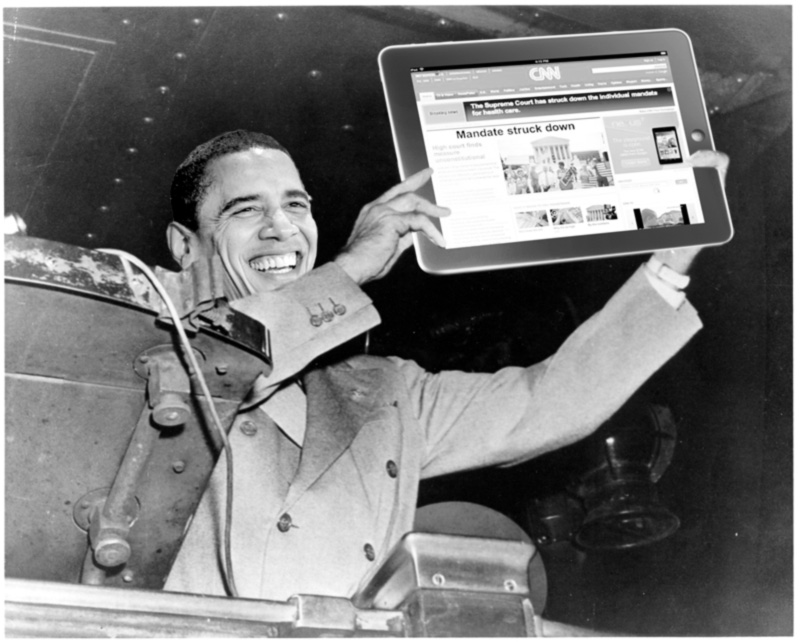
CNN, others in media, blow Supreme Court decision on healthcare… So now can we get some responsiblity in reporting?

My television tuned to the network morning programs; my browser displayed a handful of news sites and Twitter. With breakfast in hand, I was in full breaking news mode Thursday morning, awaiting word of the Supreme Court’s opinion on the Affordable Care Act. More simply, healthcare reform; more partisan, Obamacare.

A few minutes after 9 a.m. central time, every major news network was on the air, trying to be the first to summarize the 193-page opinion. CNN, the former cable news king now in dire need of ratings, was the first major source to make a declaration. Individual mandate: Unconstitutional. Healthcare law: Thrown out. On-air, online, on social media, through email blast, CNN was ready to celebrate an all-out, multi-channel, breaking news of the year scoop!

Except they were wrong. A misreading of the opinion, they claimed.

Individual mandate: Constitutional. Healthcare law: Upheld.

Courtesy Gary He (http://twitter.com/garyhe)

CNN wasn’t alone (though they were certainly most prominent). Fox News displayed the incorrect opinion on a banner during their live television coverage. A number of Republican political figures jumped the gun in celebration. Others goofed. Read all about it.

It used to be that getting a scoop mattered. Beating a competitor by an entire day in a printed newspaper really meant something. But today, when information is disseminated over various channels within minutes (or seconds) of each other, does being first really mean that much? Is it worth being wrong? Ask CNN. Sure, the tagline could have read: “We get you the news 11 seconds before the other guys.” Enviable, to be sure. Instead, they made “The most trusted name in news” read like a relic from a time when their newsroom had some sense.

Continue reading “CNN, others in media, blow Supreme Court decision on healthcare… So now can we get some responsiblity in reporting?”

Sports blackout rules don’t fit Internet Age

In a society whose entertainment is increasingly Web-centric, it was only a matter of time before technology caught up with our desire for streaming video anywhere, anytime. For most, that now means Hulu and Netflix. For sports fans, the next generation arrived with ESPN360 ESPN3 WatchESPN (Reliable service; inconsistent branding). Loads and loads of sporting events from the worldwide leader. Stuff that was airing on ESPN or ESPN2, plus tons of smaller college and second-tier sports not televised anywhere. Watch it live, watch a replay, watch on your computer, on your TV, on your phone. The future is now! Unless:

“We’re sorry, this game is not available in your area.”

Ah, the regional blackout. Designed to protect television and radio networks from hemorrhaging audience share to competing outlets, thus insuring lucrative broadcast rights, blackouts are part of making the games work financially for all parties. Traditionally, it kept national broadcasters from airing games in the two teams’ hometown markets. So, if ESPN wanted to nationally televise a game between the Tampa Bay Rays and the Detroit Tigers, they can do so. But, folks in Florida and Michigan wouldn’t be able to see the ESPN broadcast, because local television contracts require that the hometown broadcast be the only show in town. Same thing for the NBA, NHL, and major college athletics. There are exceptions, but you get the general principle.

(The NFL blackout policy is much worse. Comparable to a ransom, it further requires a team to sellout its stadium before a game can be televised in that team’s home market. You want TV? Buy up our outrageously priced tickets. At times, it has led to TV stations and advertisers buying up remaining seats at the league’s 72-hours-to-kickoff deadline.)

The Internet messed this up. People are becoming more accustomed to receiving content whenever and wherever they please. And they can… except when it comes to sports, where the old blackout rules carried over into the digital age.

Continue reading “Sports blackout rules don’t fit Internet Age”