CNN, others in media, blow Supreme Court decision on healthcare… So now can we get some responsiblity in reporting?

My television tuned to the network morning programs; my browser displayed a handful of news sites and Twitter. With breakfast in hand, I was in full breaking news mode Thursday morning, awaiting word of the Supreme Court’s opinion on the Affordable Care Act. More simply, healthcare reform; more partisan, Obamacare.

A few minutes after 9 a.m. central time, every major news network was on the air, trying to be the first to summarize the 193-page opinion. CNN, the former cable news king now in dire need of ratings, was the first major source to make a declaration. Individual mandate: Unconstitutional. Healthcare law: Thrown out. On-air, online, on social media, through email blast, CNN was ready to celebrate an all-out, multi-channel, breaking news of the year scoop!

Except they were wrong. A misreading of the opinion, they claimed.

Individual mandate: Constitutional. Healthcare law: Upheld.
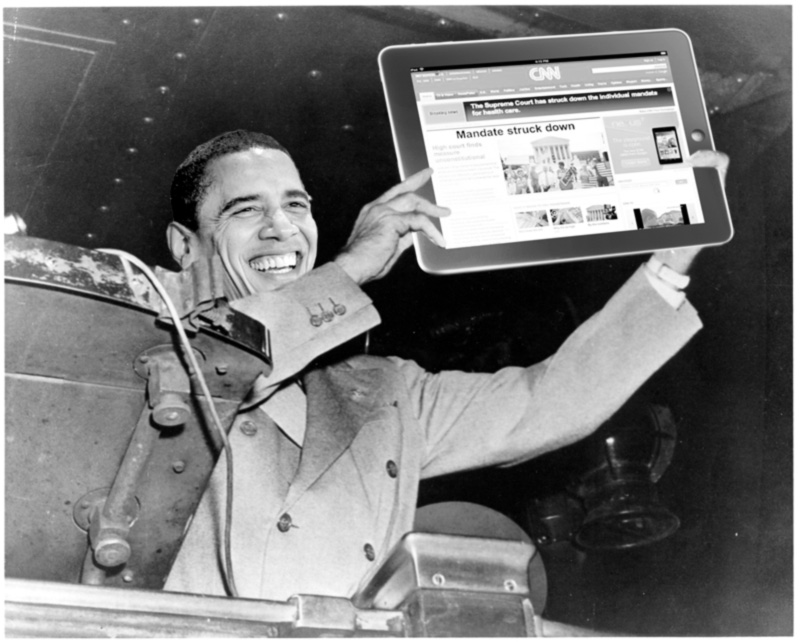
Courtesy Gary He (http://twitter.com/garyhe)

CNN wasn’t alone (though they were certainly most prominent). Fox News displayed the incorrect opinion on a banner during their live television coverage. A number of Republican political figures jumped the gun in celebration. Others goofed. Read all about it.

It used to be that getting a scoop mattered. Beating a competitor by an entire day in a printed newspaper really meant something. But today, when information is disseminated over various channels within minutes (or seconds) of each other, does being first really mean that much? Is it worth being wrong? Ask CNN. Sure, the tagline could have read: “We get you the news 11 seconds before the other guys.” Enviable, to be sure. Instead, they made “The most trusted name in news” read like a relic from a time when their newsroom had some sense.

Continue reading “CNN, others in media, blow Supreme Court decision on healthcare… So now can we get some responsiblity in reporting?”

Sports blackout rules don’t fit Internet Age

In a society whose entertainment is increasingly Web-centric, it was only a matter of time before technology caught up with our desire for streaming video anywhere, anytime. For most, that now means Hulu and Netflix. For sports fans, the next generation arrived with ESPN360 ESPN3 WatchESPN (Reliable service; inconsistent branding). Loads and loads of sporting events from the worldwide leader. Stuff that was airing on ESPN or ESPN2, plus tons of smaller college and second-tier sports not televised anywhere. Watch it live, watch a replay, watch on your computer, on your TV, on your phone. The future is now! Unless:

“We’re sorry, this game is not available in your area.”

Ah, the regional blackout. Designed to protect television and radio networks from hemorrhaging audience share to competing outlets, thus insuring lucrative broadcast rights, blackouts are part of making the games work financially for all parties. Traditionally, it kept national broadcasters from airing games in the two teams’ hometown markets. So, if ESPN wanted to nationally televise a game between the Tampa Bay Rays and the Detroit Tigers, they can do so. But, folks in Florida and Michigan wouldn’t be able to see the ESPN broadcast, because local television contracts require that the hometown broadcast be the only show in town. Same thing for the NBA, NHL, and major college athletics. There are exceptions, but you get the general principle.

(The NFL blackout policy is much worse. Comparable to a ransom, it further requires a team to sellout its stadium before a game can be televised in that team’s home market. You want TV? Buy up our outrageously priced tickets. At times, it has led to TV stations and advertisers buying up remaining seats at the league’s 72-hours-to-kickoff deadline.)

The Internet messed this up. People are becoming more accustomed to receiving content whenever and wherever they please. And they can… except when it comes to sports, where the old blackout rules carried over into the digital age.

Continue reading “Sports blackout rules don’t fit Internet Age”

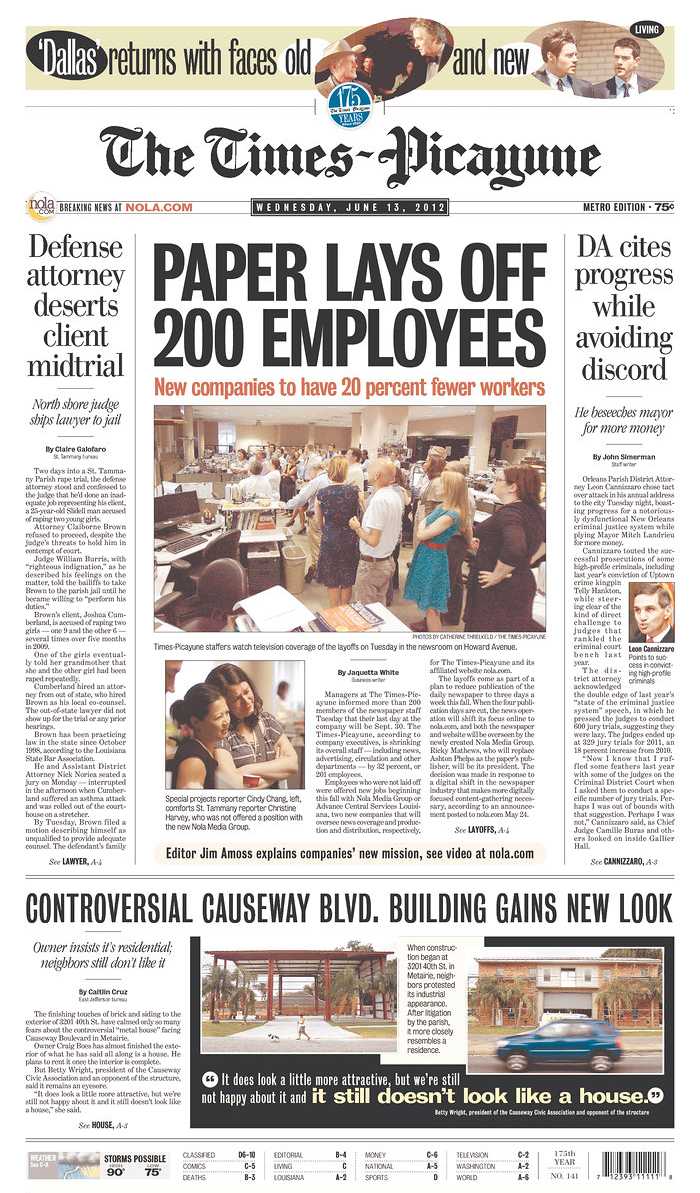
Mass layoffs or ‘job notifications’? Advance’s attempt to spin its Deep South newspaper guttings

Six hundred employees at four Deep South newspapers lost their jobs Tuesday, as Advance Publications continues its transition to primarily digital news. The cuts hit newsrooms surprisingly hard, especially in the wake of Advance’s earlier commitment to “significantly increase online news-gathering efforts” and offer “richer” “deeper” “robust” “enhanced printed newspapers on a scheduled of three days a week.”

In May, Advance announced limited print schedules and a revamped online approach for the New Orleans Times-Picayune, the Birmingham News, the Mobile Press-Register, and the Huntsville Times.

[RELATED: Times-Picayune, part of New Orleans culture, scaling back; Alabama papers hit, too]

The Times-Picayune lost 49% of its news staff on Tuesday. The Birmingham News purged 60% of their journalists. In moves that cut roughly one-third of each newspaper’s overall staffing, it would seem that the actual news gatherers were hit disproportionately hard.

Advance promises that a portion of these positions will be refilled, no doubt by less experienced, more affordable reporters. Still, fulfilling the watchdog role of the press is awful tough work when there aren’t capable bodies there to do the groundwork.

And if yesterday’s events were any indication, the NOLA and AL media groups are going to have a lot of trouble covering their respective cities. Just look at how poorly they covered themselves…

Continue reading “Mass layoffs or ‘job notifications’? Advance’s attempt to spin its Deep South newspaper guttings”